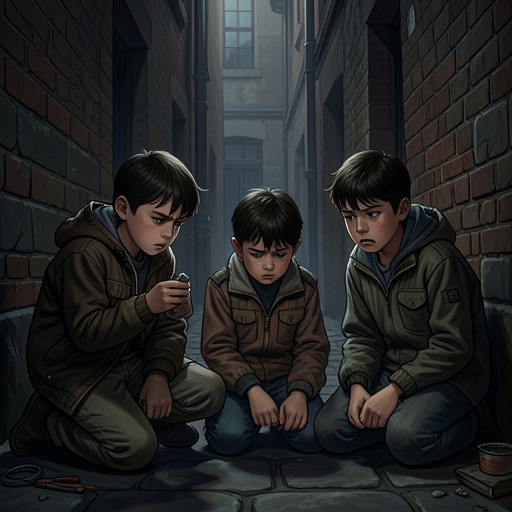
Loyalty and covering for friends
Sonne und BetonLoyalty and covering for friends is both a source of care and a pressure toward risk in the boys’ lives. It appears in practical gestures—reserving Gino’s share of stolen money, warning a friend not to inform, and going to the hospital with an injured companion—but also in decisions that deepen danger. The book does not present solidarity as a simple virtue: the impulse to protect can preserve friendship, yet it can also turn secrecy and violence into tests of belonging.
The Small Obligations of Friendship
When the boys divide 800 euros from the sale of three stolen computers, Julius insists that the money is not all his and sets aside 200 euros for each of the four friends, including Gino, who is absent under house arrest. Lukas considers Gino’s equal share obvious; Julius nevertheless spells out the allocation and says he will take Gino’s portion because he expects to visit him. Sanchez agrees that someone should bring it. The exchange makes loyalty tangible: Gino is included in the gains even though he could not join the sale, and his friends treat his absence as no reason to exclude him.
The cash also carries a warning. Lukas holds tightly to the two green banknotes he receives, while Julius takes the money intended for Gino with him. Later, Julius tells Lukas that Gino’s father stole the 200 euros from the computers. The promised share has become vulnerable inside the very household where Gino most needs support. Friendship can reserve a place for Gino among the boys, but it cannot by itself protect what reaches him at home.
Lukas’s loyalty also takes the form of trying to spare others a confrontation. When he and a friend are threatened by a group, he apologizes, stammers that they are in a hurry, and tries to keep them moving rather than escalate the encounter. In another conversation, he advises a worried mother that her son should take a longer bus route through Alt-Buckow to avoid people who target him. His practical answer is not a promise that friends can make the route safe; it is an adaptation to the danger. Solidarity here means offering a way through, even when the available solution is retreat.
Secrecy Against the School and the Police
The computer burglary brings loyalty into conflict with public accountability. When the Berliner Polizei tells students that three hooded male suspects were seen moving stolen computers and monitors in a shopping cart toward U-Bahnhof Zwickauer Damm, Lukas recognizes how much the authorities already know. He considers confessing and imagines that surrendering might bring a lighter punishment. Herr Schiezeth then warns the class that anyone involved, including people who knew about the burglary and did not help solve it, will be punished. The threat turns silence from a private agreement into a consequential choice.
When Lukas is about to speak with a teacher, Julius tells him to listen but not to say anything, whatever the teacher knows, and not to reveal anyone. He asks to speak with Lukas again afterward. The instruction is direct, but its emotional force lies in the dilemma it creates: keeping faith with friends means withholding information even as the school’s warning makes non-disclosure itself a possible source of punishment. The code protects the group from immediate exposure while narrowing Lukas’s room to act independently.
That same protective impulse can take a physical form. As the boys prepare to enter the school, Julius reveals a silver blank-firing gun tucked into his waistband, presenting it as something to have in case anything happens. Lukas had taken Julius’s earlier talk about it as a joke; seeing the gun makes the danger of the plan suddenly concrete. The weapon is not evidence that loyalty requires violence, but it shows how the boys’ expectation of having to protect one another can bring a weapon into an already criminal undertaking.
Gino’s Crisis and the Limits of Protection
Julius’s later account of Gino’s home life changes the meaning of his earlier acts. He says that Gino’s father beats Gino and his mother, drinks, and took the 200 euros. Gino, Julius explains, wants to escape with his mother and brother but believes his father will not let them leave. He hears his mother being beaten and feels unable to help her. Julius says he advised Gino to strike his father with a bottle only hard enough to knock him unconscious, then obtained Tilidin so Gino could overcome his hesitation if violence broke out again.
Lukas challenges this version of help at its most dangerous point. He asks how Tilidin could solve the abuse and why Julius or Gino has not called the police. Julius rejects the idea that the police can do anything, insisting that Gino’s father confines the family and will not let them go. He presents the drug not as recreation but as a way to make Gino capable of acting, and appeals to the fact that Gino is his best friend. That appeal explains Julius’s commitment without making the plan safe: his care has become entangled with an attempt to prepare Gino for a potentially lethal confrontation.
Julius’s explanation also reveals the cost of the boys’ protective code. Gino’s distress is not merely a rumor or a story about money; Julius describes a household where Gino watches violence, feels powerless, and sees escape as blocked. Yet the response available to Julius is private and improvised: advice to use a bottle, a supply of Tilidin, and a refusal to trust official intervention. The book sets Lukas’s questions against Julius’s certainty without resolving their disagreement into an easy answer. Their shared concern for Gino is clear, but their ideas of what help requires sharply diverge.
Care, Violence, and Consequence
The boys’ loyalty is not limited to agreement or concealment. When Julius attacks Cem’s girlfriend and Cem retaliates, Sanchez repeatedly intervenes to pull Cem away from Julius. Lukas joins the effort, trying to stop the fight and restrain Cem; an elbow to Lukas’s nose leaves his vision blurred before he kicks Cem away from Julius. Their actions are protective, but the scene also shows how quickly protection becomes part of the violence it is meant to contain. Friendship makes the bystanders act, while the escalating blows make intervention dangerous.
After the fight, Lukas and Sanchez accompany the battered Julius on a night bus to Klinikum Neukölln. Julius, crying and badly injured, says that he only wanted to help Gino and hopes Gino will not get into trouble. Lukas offers him a hand and an arm over his shoulder as they leave the bus and enter the hospital. The gesture does not settle whether Julius’s intervention was wise, nor does it solve Gino’s situation. It does, however, distinguish care from endorsement: Lukas can challenge Julius’s choices and still help him when he is hurt.
Across these episodes, loyalty works as an informal form of protection where school discipline, police involvement, and family authority are experienced as uncertain or threatening. It binds absent friends into a shared division of money, demands silence when discovery looms, and prompts risky efforts to rescue someone from violence. Its tenderness is inseparable from its danger: the boys do not abandon one another, but their promises to stand together can leave them choosing secrecy or force when safer forms of help are not trusted.